SOTA Production AI Agents,
not Prototypes.
Mission critical Google code and fully open source.
Any model, tools, and deploy anywhere.
 Python
 Go
Go Java
Java TypeScript
from google.adk import Agent from google.adk.tools import google_search agent = Agent( name="researcher", model="gemini-2.5-flash", instruction="You help users research topics thoroughly.", tools=[google_search], )
pip install google-adk







Build agents with agents.
ADK is designed to be written by both humans and AI. Hook up your favorite coding assistant to our MCP Server and let it generate robust, tool-bound agents in seconds.
Define your skills, bind your tools, and let your IDE do the heavy lifting.
Agents CLIContext is compiled, not concatenated.
Most frameworks paste strings into a context window until it overflows. ADK treats context as source code — sessions, memory, tools, and artifacts are compiled into an optimized view where every token earns its place.
Deduplicate tool results. Summarize old turns. Index artifacts. Budget tokens. All by default, all customizable.
Visual Debugging & Tracing
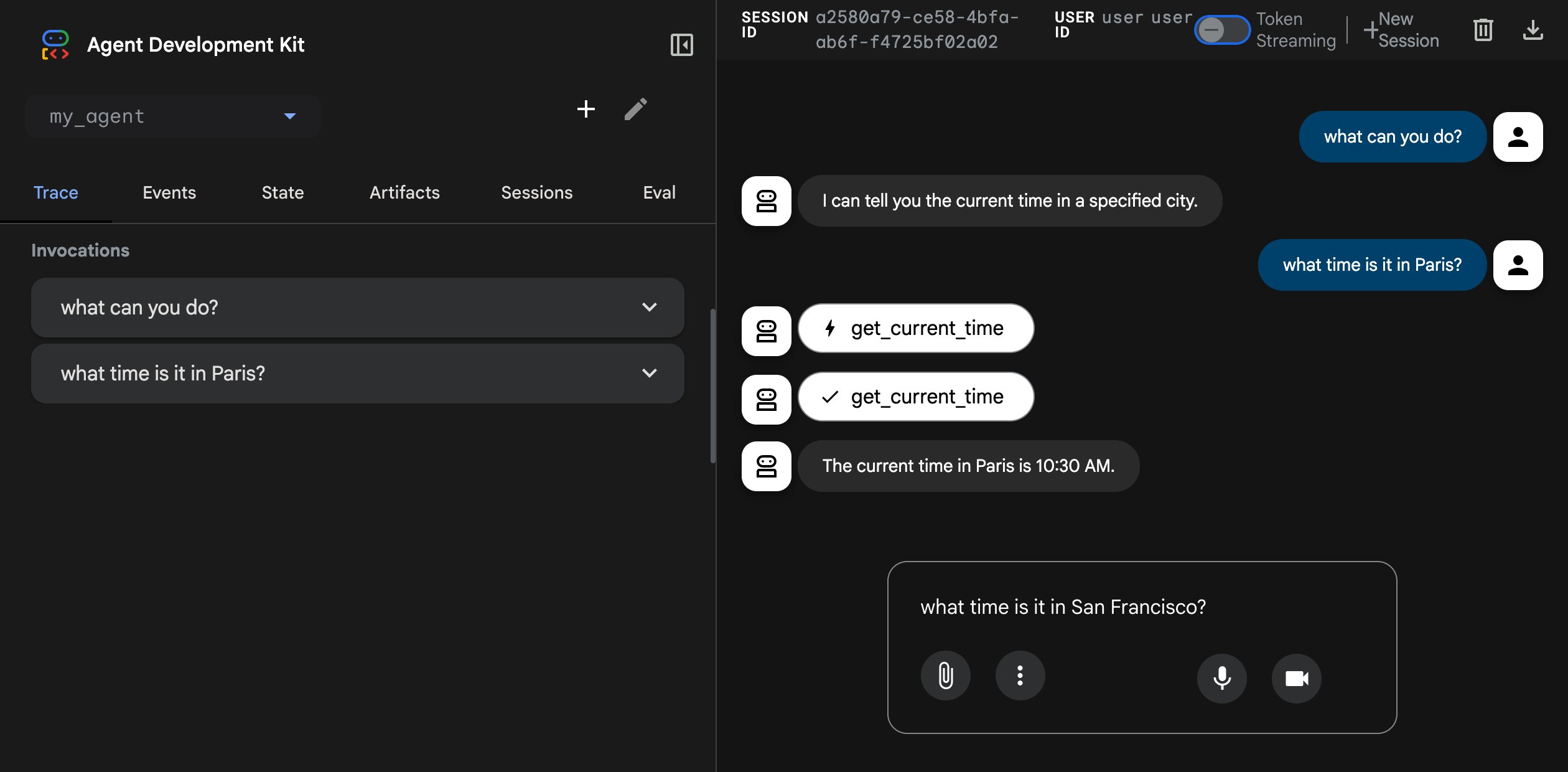
Stop printing to stdout. ADK includes a powerful interactive web UI for testing, debugging, and tracing agent behavior locally.
Inspect tool calls, modify context windows on the fly, and visualize multi-agent graph executions with zero configuration.
Go beyond vibes. Evaluate everything.
Testing agents is notoriously hard. ADK's built-in evaluation framework lets you systematically test not just the final text response, but the entire execution trajectory.
Assert that specific tools were called, check the exact sequence of graph nodes, and ground outputs against real data.
| Metric | v2.0 | v2.1 | Δ |
|---|---|---|---|
| Groundedness | 76% | 88% | +12% |
| Latency p50 | 620ms | 440ms | −180ms |
| Tool accuracy | 81% | 89% | +8% |
| Safety filter | 99.2% | 99.2% | +0% |
| Hallucination rate | 4.1% | 6.1% | +2% |
Low floor, high ceiling
Start simple. Scale to production. ADK grows with you.
5-Minute Agent
Zero to agent in 5 minutes. Define behavior in YAML or Python — no boilerplate required.
Learn more →Structured Context
Context engineering, not prompt engineering. Sessions, memory, and artifacts compiled into optimized model views.
Learn more →Multimodal Streaming
Voice, video, and real-time streaming. Build agents that see, hear, and respond in real time with the Live API.
Learn more →MCP Native
Connect 1000s of tools with zero config. Native Model Context Protocol support for extensible tool access.
Learn more →A2A Protocol
Agents talking to agents. Cross-platform interoperability with the open Agent-to-Agent protocol.
Learn more →Agent-to-UI
Agents that render, not just respond. Stream dynamic, generative UIs as structured payloads.
Learn more →Built-in Guardrails
Safety by default. Input/output guardrails, content filtering, and callback-based safety checks.
Learn more →Evaluation Framework
Go beyond vibes. Test response quality, tool accuracy, and full execution trajectories systematically.
Learn more →Native Observability
Full visibility into every agent decision. OpenTelemetry tracing, tool call inspection, and reasoning logs.
Learn more →Session Rewind
Time-travel debugging for agents. Replay and inspect any point in a conversation's history.
Learn more →Workflow Graphs
Deterministic when you need it. Graph-based agents combine AI flexibility with reliable control flow.
Learn more →Deploy Anywhere
Agent Engine or your own infra. One-command deploy to Google Cloud, or run on any platform.
Learn more →Frequently Asked Questions
How ADK compares, what it does, and why it exists.
How is ADK different from other AI agent frameworks?
ADK is Google's production-grade framework for building AI agents. Unlike prototyping tools, ADK gives you structured context management, built-in evaluation, visual debugging, and a clear path from local development to enterprise deployment on Google Cloud. It's opinionated where it matters and fully customizable where you need it.
Can I use ADK for vibe coding with AI?
Yes — ADK is designed to be written by both humans and AI. Connect your favorite coding assistant (Gemini CLI, Claude, Cursor) to ADK's MCP Server and let it generate robust, tool-bound agents in seconds. Vibe code your agent, then harden it with ADK's evaluation and testing tools before deploying to production.
Does ADK work with Gemini CLI?
ADK and Gemini CLI are complementary. Use Gemini CLI to scaffold projects with agent-starter-pack, generate agent code, and iterate rapidly. ADK provides the runtime — context management, tool orchestration, session handling, and deployment — that turns Gemini CLI output into production agents.
How do Agent Skills work in ADK?
Agent Skills are reusable capability packages that other AI agents can discover and use. Define your agent's skills with structured metadata, and any MCP-compatible coding assistant can understand what your agent does and generate code that uses it. Skills make your agents composable building blocks, not monoliths.
Can I build AI agents without writing code?
ADK supports multiple entry points. Use agent-starter-pack for template-based scaffolding, Gemini CLI for natural language agent creation, or the ADK Web UI for visual testing and debugging. For production agents, you'll want code — but you can start without it and add structure as you go.
How does ADK integrate with Google Cloud and Vertex AI?
ADK deploys natively to Google Cloud via Agent Engine (Vertex AI), Cloud Run, or GKE. You get managed infrastructure, built-in authentication, Vertex AI model access, Cloud Trace observability, and enterprise security — all without changing your agent code. Develop locally, deploy to Google Cloud with one command.
Is ADK locked to Gemini models?
No. ADK works with any model — Gemini, Claude, GPT, Llama, Mistral, or any OpenAI-compatible endpoint. It's optimized for Gemini (native tool calling, grounding, multimodal) but designed to be model-agnostic. Swap models with a single line change.
What's the difference between ADK and LangChain / CrewAI / AutoGen?
ADK is built for production, not just prototyping. Key differences: structured context compilation (not string concatenation), built-in evaluation framework, visual debugging UI, native multi-agent orchestration, and a direct path to enterprise deployment on Google Cloud. It's also fully open source with P0 Google engineering quality.
Can I use ADK as an agent platform for my team?
Yes. ADK scales from single-developer projects to team-wide agent platforms. Deploy agents as services with A2A (Agent-to-Agent) protocol support, manage sessions and state across users, add authentication and authorization, and monitor everything with built-in observability. Agent Engine on Vertex AI provides the managed infrastructure.
Is ADK open source?
Fully open source under the Apache 2.0 license. Available in Python, Go, Java, and TypeScript. The same code that runs Google's internal agent infrastructure is what you get. No proprietary lock-in, no "enterprise edition" — everything is in the open.